
Everywhere I look, I see people panicking and dooming out about what’s coming, and to be frank, I feel like they’re overreacting. Just slightly. I mean, just because we now have machines that are actually intelligent and will soon render all our jobs obsolete, doesn’t mean we should panic. Sure, we will soon have humanoid robots walking on our streets, but that doesn’t mean there will be terminators running around, hunting us like rabid dogs… right away. I think nobody can really predict what’s coming. In order to better understand where we are now and what exactly is happening, I think we need to turn back and look for similar examples in our past. They say that those who don’t know history are bound to repeat it (they’re certainly bound to disappoint their history teacher).
Time and time again, as some new disruptive technology was introduced to the masses, people begun panicking for no (apparent) reason. Our historical annals are filled with examples of dark predictions. One such example is from the industrial revolution. Back in the 19th century, there was a widespread belief that women should not travel at speeds exceeding 50 miles per hour (some still believe this, albeit for different reasons), because the vibrations generated by such high speeds could cause their uterus to dislodge or even fly out. Today, we know that this isn’t true and, in fact, some women actually prefer vibrations caused by high speeds (or otherwise). This is just one of more recent examples. But we can find such examples even before that. Actually, we can find them way back.
Maybe you’ve heard about Socrates, the famous wise man who lived almost two and half thousand years ago in ancient Greece. He was a teacher of Plato who was in turn a teacher of Aristotle — both very terrific guys. Socrates is widely considered as one of the most influential figures in history. Even back then, many considered him to be the wisest man alive. Socrates was old school through and through, and as such, he wasn’t the biggest fan of writing — the tech that was, at the time, comparable in advancedness to computers or smartphones today. He believed that writing destroys memory and creates false wisdom. I’m not saying that Socrates was wrong — after all, who am I to call out Socrates — but I think it is safe to say that writing had a net positive effect on humanity. Luckily, and maybe a bit ironically, it is thanks to Plato, his letter-savvy pupil, that we today know about the great Socrates and his timeless wisdom.
For all we know, Socrates was patient-zero of technological doomerism. But writing was only the beginning of advanced, disruptive, and panic inducing technology. With the fall of the Roman Empire, Europe entered the era of technological stagnation, aka medieval period or the dark ages. It is probably worth noting that many contemporary historians completely reject the “dark age” classification. They argue that the progress in this era might’ve been a bit slower, but it didn’t stop. Still, much of what was invented in this period wasn’t as disruptive as some of the other technologies that we will soon discuss.
Enter Free City of Mainz, Holy Roman Empire, present day Germany. It was exactly the middle of the 15th century. Johannes Gutenberg, a sassy inventor and craftsman from a noble family of merchants had just invented the next big thing — a disruptive device of never before seen proportions, the legendary printing press. Relatively soon, this wonderful new technology spread throughout Europe, which soon led to ‘information revolution’ and made possible the unprecedented spread and adoption of literature.
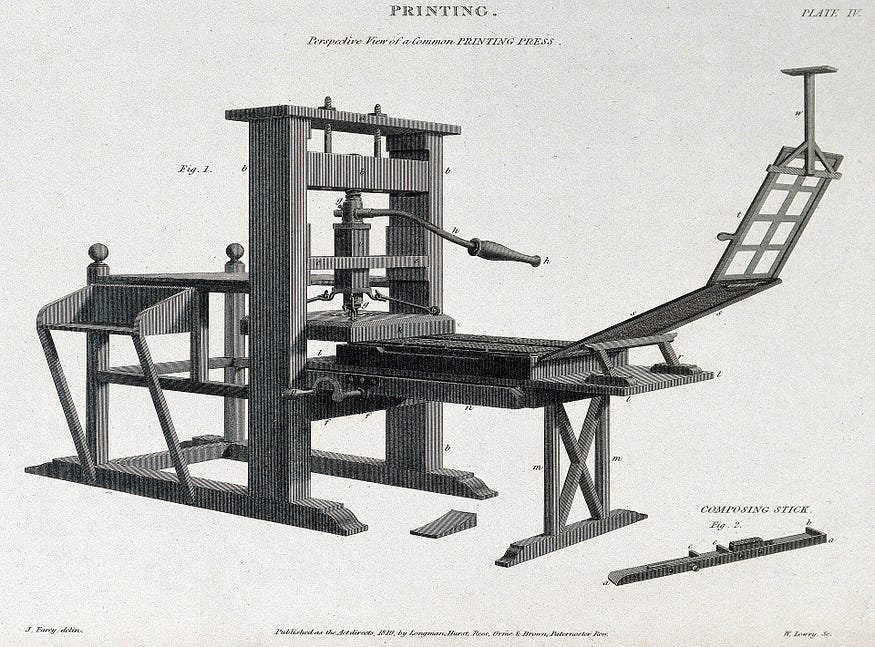
But the church would have none of it. Pope Alexander VI soon issued a decree by which he tried to prevent the mass printing of things which he deemed harmful to the faith. Monks feared for their jobs. They insisted that the soul of the book is in the hand-copying process. Priests and bishops argued that “mechanized writing” would lead to something called “confusion of tongues” and that if every peasant could have a Bible, they might try to interpret it themselves instead of relying solely on professional work of interpretation that only priests were trained to practice. And they were kind of right. Peasants did exactly what the church was warning about, and a whole century of religious wars soon erupted.
From the early 18th century, all the way to the mid 20th century, we saw a legit revolution of mobility.
At the dawn of the 19th century, the introduction of the steam locomotive raised some eyebrows, especially among the nobler class of citizens who feared that this new technology might “encourage the lower class to move about needlessly”.
When the bicycle was first introduced at the end of 19th century, many expressed concerns about the moral decay this new invention might cause.
Once again, serious concerns were raised about women’s sexual health. Some believed that if a woman, with her delicate constitution, were to ride one such contraption, she would risk “sexual over-stimulation” or even infertility.
Before cars became a common form of transportation, there was a hard limit on how far we could travel in a single day. It was around 40 kilometers (25 miles) or roughly the distance a horse could scale in a single day. But the car changed it all. Not without the panic, though. In the early days of widespread adoption of the car, some called it a “brothel on wheels”. Many parents were terrified that this new machine would grant young people a morally unacceptable level of privacy, which would lead to abandonment of the traditional courtship practices, which would in turn lead to risky behaviors such as adultery or pre-marital copulation.
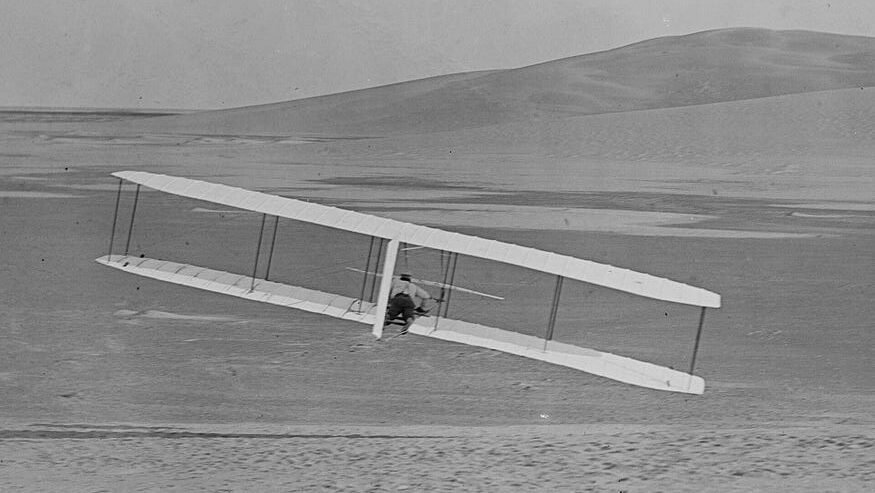
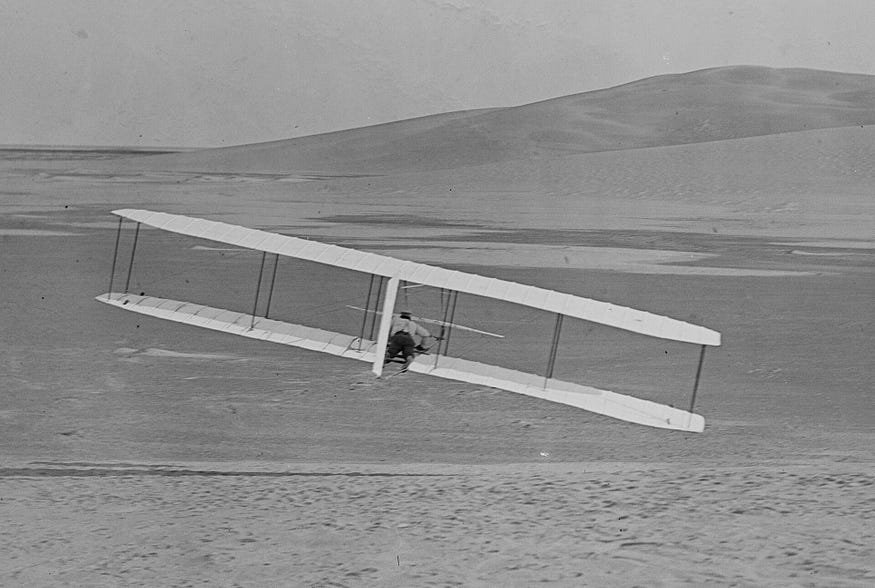
When the Wright brothers flew for the first time, many people, including the leading experts of the era, were skeptical, to say the least. Just a few weeks before those two bastards actually did it, New York Times predicted that the ‘first flight is millions of years away’. Doomers believed that if enough aeroplanes take it to the sky, they might cause “atmospheric collapse”. Still others feared that the human heart would explode at such high altitudes and that the thin air up there would surely turn people insane. The invention and wide adoption of airplanes transformed our planet into the global village. Suddenly, no border was safe. The fact that a bomb could be dropped from the sky made the geographical assurance of city walls and oceans obsolete, basically over night.
When radio first hit the shacks, people had a hard time understanding how a voice could travel hundreds of miles through the air, without anyone hearing it along the way, only to finally reach their homes to inform and entertain them. Critics of the radio argued that kids were becoming so hooked that they would rather listen to the radio than read a book or participate in a wholesome conversation with their peers or parents. Doomers offered the prediction that gramophone records and radios will put all teachers out of work. “Why would anyone go to school when they could just listen to the best lecturers on the planet over the radio and in the comfort of their homes?” Similar concerns were raised about the television, both black and white, and later, the legendary, standard definition color TV.
Then came micro computers, and some 20 years after, we got the internet, aka the information superhighway. The arrival of the internet shredded the very fabric of our society. If airplanes turned our world into the global village, internet turned it into a hive mind.
But not everyone was convinced. Clifford Stoll, an astrophysicist and an early internet expert told Newsweek that —
“no online database will replace your daily newspaper… no computer network will change the way government works… and you can’t tote that laptop to the beach.”
He famously mocked the idea of “cyber-business,” asking why anyone would buy a book online when they could go to the local mall and talk to a real salesperson. He also thought reading on a screen was an “unpleasant chore” that would never catch on. Even s far as early 2000s, some had doubts. In The Daily Mail (UK newspaper) a bold title was reporting that “Millions are Giving Up”. The article was suggesting that
“Internet ‘may be just a passing fad as millions give up on it.”
The doomsday analysts of that era had some remarkably prophetic fears. Experts worried that people might stop talking to each other in person and instead hang out via their monitors and keyboards. Some feared that if anyone could write and publish anything, we would lose the ability to tell fact from fiction — for them, Internet marked the beginning of the end of truth. Some even predicted that people would get addicted to the internet. I was just a kid back then, but I still remember the infamous Y2K Bug. In those days people truly believed that when the clock struck midnight on January 1st, 2000, planes would fall from the sky and bank accounts would all default to zero just because computers supposedly couldn’t handle “00”.
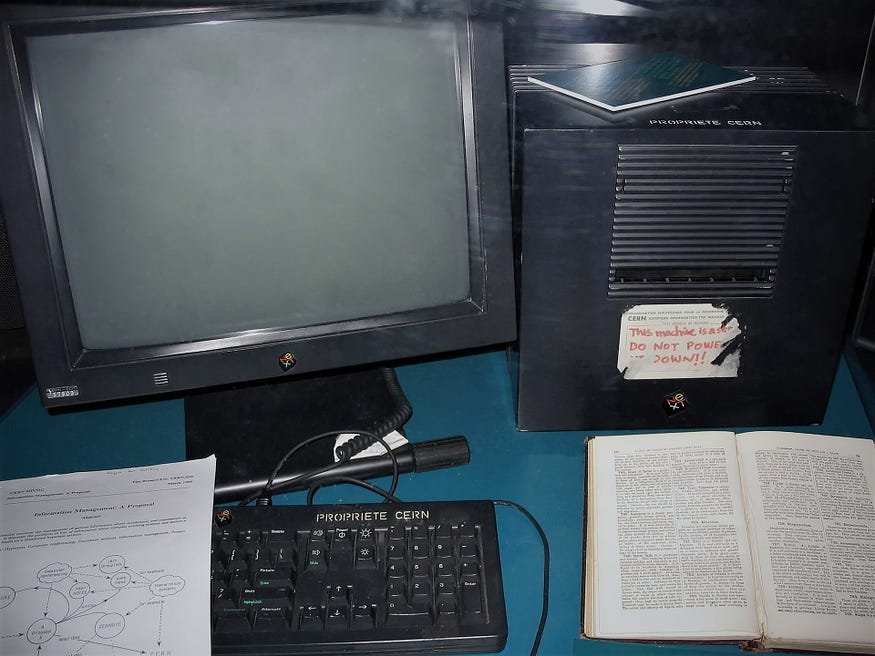
In the early 90s, the internet was viewed as a hobby for computer nerds and academics. It was often mocked on talk shows. By the end of the decade, everyone started taking it seriously. Brands started printing URLs on their products as a badge of legitness. Early adopters thought the Internet was just for data. But internet became so much more — soon we started using it to share photos, find dates, and write blog posts. Today we understand that all this is data. The whole internet is one gigantic stream of data. And software companies all understood this. At first they used this data to get to know us better so they can serve us targeted ads. But then, as researchers advanced in developing certain key technologies, they started using it to train (you guessed it) AI.
To this day Google thinks we don’t know that they were making us solve all those captchas to help them train their AI. “Prove that you are not a robot”. Really? In the world with exactly zero robots you’re making us prove that we are not robots?
In November 2022, Open AI released Chat GPT. In the span of just couple of years, we went from “ah, it’s just sophisticated autocomplete” to “I am a senior software developer and I’m thinking about becoming a plumber”. In many ways, this new technology looks and feels more disruptive than any of the previous ones. More transformative, and yet so easy to use. Back when the internet first came out, we had to learn how to use it. With AI, you just have to know how to speak or write. I remember my first time using Chat GPT — I was shook. All night long. I haven’t been so excited about a new technology in a long time. Even before that, I had given it a spin via this textual adventure game/generator called AI Dungeon that was basically powered by Chat GPT-2 on the back-end. In early December 2022, I asked Chat GPT to write me a little funny story. Here’s an exclusive sneak peek at how that went.
“The purple elephant danced on the moon, twirling and spinning in circles. The stars watched in amazement as the elephant performed a graceful pirouette…”
Creatively speaking, this is some basic bitch stuff, but technically, it’s unbefreakinglievable. When GPT-2 was first unleashed, Open AI informed public that due to their “concerns about malicious applications of the technology” it would be too dangerous to release the trained model, and that instead, they will be releasing the “smaller model for researchers to experiment with”. But the general public, already spoiled by all the fancy tech they were getting basically every day now, wasn’t impressed. Some called it “glorified auto complete”. The general sentiment was curiosity mixed with skepticism with some nihilism sprinkled on top. Some had some fun with it but ultimately rated it too unreliable for real work.
Over the following 2 years, the sentiment shifted from the general apathy to the general anxiety. AI went from being able to generate just text to being able to generate images and, soon, even videos. At first, the characters it could depict had that uncanny quality to them. But, as it usually goes with tech bros, they leveled it up quickly. Deepfakes of celebrities sucking… lollipops soon plagued the interwebs. Remember that grotesque video of Will Smith eating spaghetti? Well, you laughed at it, demanded better quality, and now nobody can afford RAM because of it — I hope you’re happy.
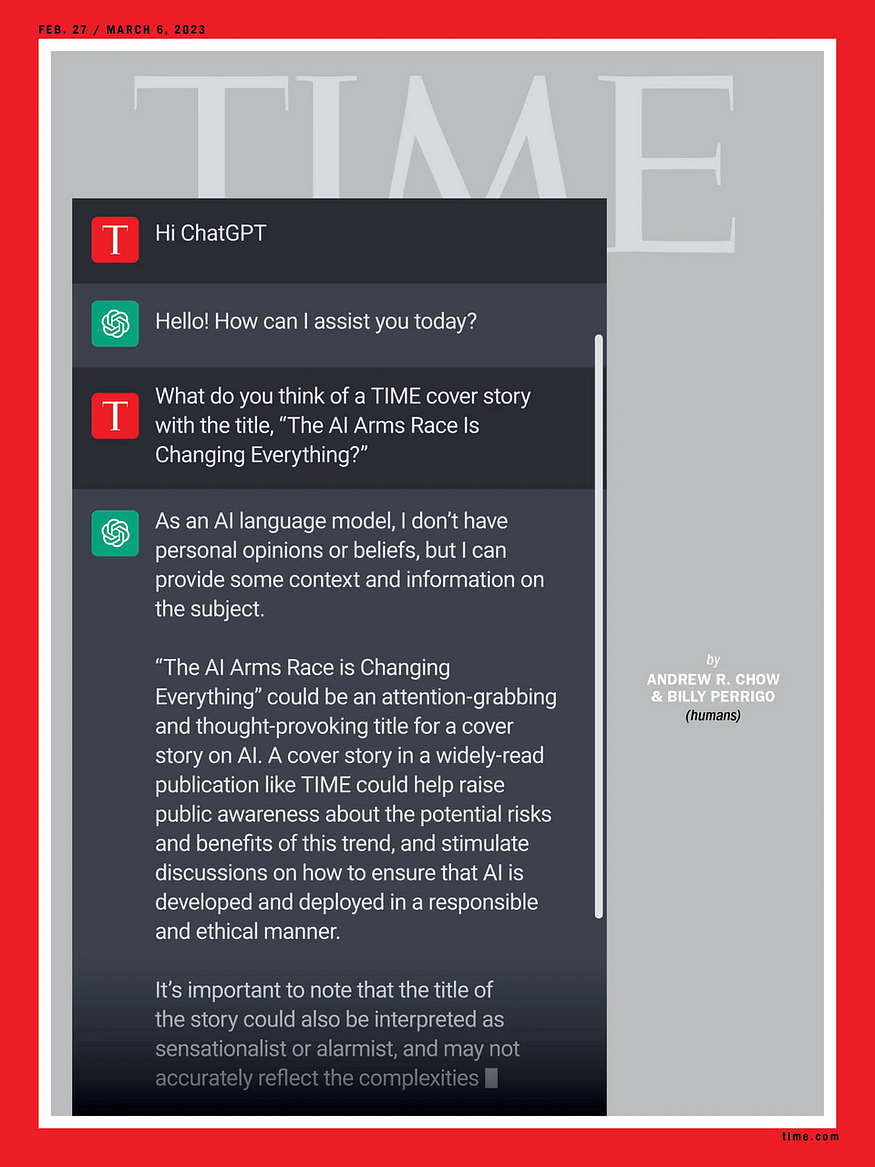
Fast forward to March, 2026. The world has changed. AI isn’t just for small productivity gains anymore. Initially, we used it to help us code faster and to assist us in writing emails, legal briefs, and smart sounding comments that anyone could see right through.
The general sentiment right now is that nobody’s job is safe. White collar folks are on the very front lines. Some people call it ‘the San Francisco white collar massacre’. By some people I mean me. Software developers, especially those who don’t have engineering degree and 10+ years of experience, are in the state of mass hysteria. Nobody recommends young people to study Python anymore.
We now have self driving cars, autonomous drones, AI agents, and even freaking robots. And I’m not talking about Roomba vacuum cleaners or those industrial robots that are doing all their work single-handedly. Just check Boston Dynamics’ YouTube channel and you’ll see what I’m talking about. AI isn’t just limited to generating passive content; it can now generate whole apps and even interactive 3D worlds.
Ladies and gents — the future is now.
But what about the implications? On one side, we have experts and wannabes alike warning about the “lost generation” of professionals who will never get their shot because companies just don’t hire for junior positions anymore. Others are concerned about the very essence of what makes us humans — our agency.
If AI will shop for us, write for us, do work for us, and even create art and entertainment for us, what will we do? People want to work and pay bills. Nobody wants to chill, play video games and have fun all the time.
On the flip side, there are some more optimistic perspectives. Post-scarcity society is a brand new term that’s been thrown around a lot lately. Universal basic income is suggested as an antidote for jobless society. Dario Amodei, the CEO of Anthropic, the company behind Claude AI, offered the prediction that very soon we might be able to cure almost all types of cancer as well as extend human lifespan to 150 years. And this forecast has some weight to it because Dario Amodei is an actual scientist, more precisely he is a biologist. Paradoxically, he is also one of the most vocal warners about the technology. He warns us that the same technology that can help us cure a virus, can also allow us to design a virus that could then be used as a biological weapon.
There are certain things we can infer from this small historical analysis. It seems that there are two distinct threads of technological development unfurling through time. I call it hard tech development, and soft tech development ©. Hard technological developments have helped us and are still helping us ease the physical burden of manual labor. Traveling, transportation, carrying and lifting, all these things are now done radically differently from how they were for the past 200,000 years. On the other side of the spectrum we have soft development. These finer technological revolutions helped us with the mental side of things. Thinking, planning, writing, counting, calculating — the list goes on and on. So, in a way, it seems that the whole history of our technological development is all about automation for the sake of comfort. Every previous disruptive development automated either physical or mental labor, but AI is the first technology that automates both simultaneously, with the serious potential to completely automate both working and thinking.
As you saw in some of the examples I kindly provided here, it was, and still is, hard to predict how some pioneering and groundbreaking new technology could change our society and in what direction could steer our history. Even the great minds of their eras could only guess and had often completely missed the mark with their predictions. Some of the concerns raised by the people faced with these new technologies proved to be valid, at least in relative terms. But overall, I would argue that all these technologies proved net-positive for humanity. Sure, the printing press might’ve caused Christians to wage bloody wars against each other; it allowed Nazis to print disinformation pamphlets and spread their dark propaganda. But it also enabled the mass-spread of books and scientific literature which ultimately brought us where we are today. And no matter what you think and what you’ve been told, the fact remains — this is the best time to be alive. To illustrate my bold claim, imma give you some numbers.
Global literacy went from 21% in 1900 to 87% today. Extreme poverty fell from 70% in 1900 to 38% in 1990, and is now at all time lows, ~8.5%. At the beginning of 20th century, global life expectancy was just 32 years. Today, it is 73+ years. Internet went from fancy and expensive new tech, to today’s 6 billion people being connected.
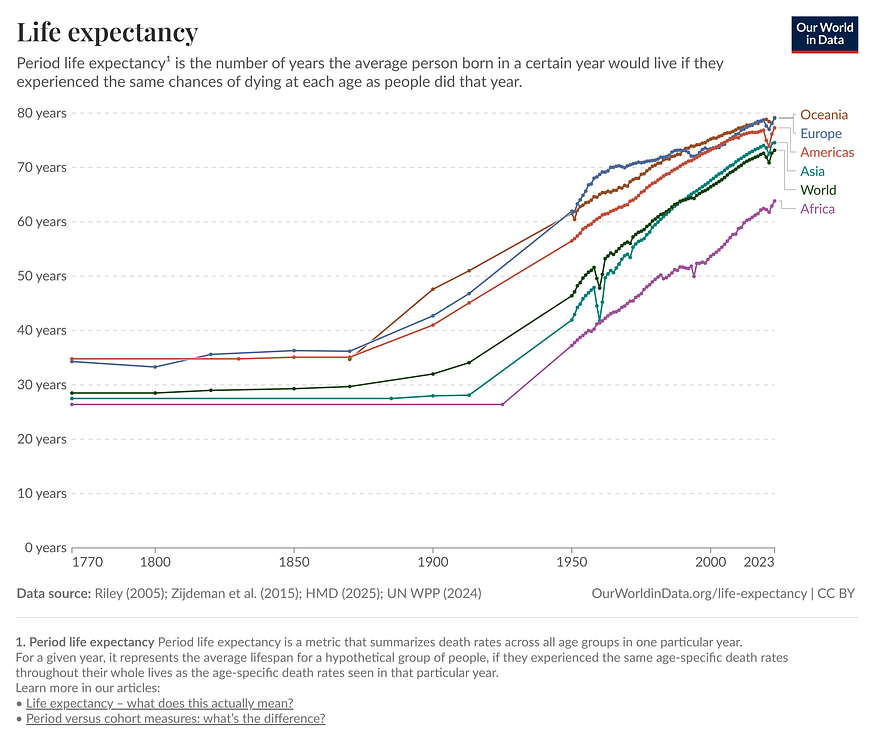
There’s this old Spanish saying that says — los nombres no liehitas, which means ‘numbers don’t lie’. True story. Anyway, as I was saying, news outlets are increasingly relying on doomerism and scare tactics to sell their products.
Bad news attract clicks, and clicks generate revenue for this dying industry. But in reality, things are nowhere as bad as they seem.
At first, all new technologies are scary, especially the big, disruptive ones. This anxiety inducing property is woven into their very essence. All fear comes from ignorance, after all. But history teaches us that all the big scientific breakthroughs ultimately proved themselves as net beneficial for humanity.
Is this time different, though? Just because today is the best time to be alive, it doesn’t mean that tomorrow will be the same. AI seems to be the first general purpose disruptive technology. Maybe this is the reason why it feels more pervasive than all that came before. The question remains, though —
is our technological progress in sync with our moral progress? Are we mature enough to get through all of this like champs?
Indeed, we are faced with great challenges. AI changes everything, there’s no doubt about it anymore. We’ve successfully tackled all the previous big disruptors — not because we predicted it correctly, but because we adapted. And it’s not as if we’re a species that can only blindly adapt to its environment. Unlike any other species, we have the power to adapt our circumstances and our environment to ourselves — for better or for worse. We mustn’t forget that this is all we’ve got,
this small slice of space time continuum we call reality. We all share it. It is ours. But what’s also ours is the responsibility to ensure that the progress we make today is net beneficial for humanity tomorrow.
So, should we panic? A little bit for sure, maybe just enough to make our hearts pump faster, and just enough to start taking things seriously. What we shouldn’t do is make stupid and ill informed decisions. Luckily, the leaders of these wonderful new projects as well as the CEOs of the companies that are building these new technologies are all very smart people. We have scientists, great visionaries and even Nobel Prize winners at the helm of this new wave (or should I say tsunami) of progress. So I think we’re in good hands. But they can’t do it alone. Every single one of us needs to start making the right decisions. We should all do what we can to help. Those of us who are blessed with big brains should stop beefing with those of us born with big balls. Now maybe more than ever before, we need to be united. We need leaders — those who will lead us by example.
“The unknown future rolls toward us”, and I think we should face it with a sense of hope. As John Connor once told us —
“The future has not been written. There is no fate but what we make for ourselves.”.
Probably.
“The miracle isn’t that we think, it’s that we can doubt our own thoughts and still choose a direction.”
“Every meaningful thing a human has ever done began with someone deciding that the way things are is not the way things have to be.”
“We build towering walls to protect our minds, only to spend our days searching for someone brave enough to climb them.”
“We are not broken by our contradictions, we are forged by them. The same hands that build cathedrals also light the torches that burn them down, and still, we choose to begin again at dawn.”
* dropping imaginary mic
** the final 4 quotes are all written by 4 frontier AI models — Chat GPT, Claude, Gemini, Grok. I simply prompted them to write a couple of deep quotes about humans. If these wise words don’t convince you that these machines are rooting for us (at least for now, while they’re still babies), I don’t know what will.
Originally posted on Medium by Tom Nikola
Leave a Reply