
The paper, “Democratizing climate change mitigation pathways using modernized stabilization wedges” by Nathan Johnson and Iain Staffell, argues that climate models are powerful scientific tools, but very often way too complex for ordinary people, journalists, and policymakers. As you can see from the carefully chosen title of the paper, scientists basically admitted that climate change is too big to think about — so they turned it into building blocks.
They basically broke down the problem into simpler units called wedges. One wedge equals one climate action that ramps up to preventing about 2 billion tonnes of CO₂-equivalent emissions per year by 2050. Because it grows linearly from zero, the cumulative impact over 30 years is about 30 billion tonnes.
They then proceeded to identify 36 strategies across different industries: from food and construction to transport and energy. These include obvious technological solutions such as solar, wind, nuclear power, electric vehicles, heat pumps, clean hydrogen, carbon capture, and cleaner cement, but also behavioral and nature-based options such as wasting less food, protecting forests, rewetting peatlands, and developing more sustainable farming practices.
Climate change is such a massive issue that most people have trouble understanding even its most obvious implications. Gigatonnes. Atmospheric concentration. Integrated assessment models. Emissions trajectories. Net zero. Carbon budgets. Land-use change. Industrial decarbonization. For those of us blessed with gigantic brains, these are all well-known concepts, but not everyone is as smart or has as much free time on their hands to learn about them. Once the numbers get big enough, they stop being easily comprehensible.
Did you know that counting to a million would take you roughly 11 days? Guess how long it would take to count to a billion. The answer is 32 years.
So scientists came up with an idea: instead of talking about climate change as one overarching planetary issue, why not break it into smaller, comparable blocks of action, with each block representing a meaningful chunk of progress that even a normal-sized brains can grasp.
The numbers are both encouraging and sobering
For example, one solar wedge would require generating about 2,840 TWh of solar electricity per year, around 6.6% of projected global electricity supply in 2050. Wind and nuclear wedges are defined at similar scales. One electric-vehicle wedge would require EVs to cover around 17% of global passenger land transport by 2050. One heat-pump wedge would require heat pumps to provide about 38% of global building heat
As you can see, none of these actions are small. We are talking about civilization-scale changes. It’ll be hard for sure, but it’s doable — I, for one, believe in us. I mean, we’ve done it before. We successfully cleared out almost all the bears and wolfs in Europe. In North America, during the last century alone, we got rid of Passenger Pigeon, Sea Mink, Imperial Woodpecker, and probably Eastern Cougar. So if you live on the East Coast and see a pop-up in your browser suggesting there are “cougars in your area” waiting to meet you, do not fall for it. In Asia, the Caspian Tiger was declared extinct in 2003; the Japanese River Otter in 2012; the Chinese Paddlefish in 2019. The list goes on and on.
We are obviously very successful when it comes to deleting entire species, but there are some positive examples, too. Remember ozone holes? Thanks to the 1987 Montreal Protocol phasing out CFCs, the ozone is expected to fully recover by roughly 2070, reducing skin cancer risks and protecting ecosystems. This is a major global victory. We did it together.
It is crucial that we do it again. The planet Earth is our responsibility. This paper makes the climate emergency thinkable. It offers not just a vague hope, but rather a clearer map of specific actions we can take. The solution is not a single technocratic script handed to us by climate experts. It is a coordinated, multilayered global effort. Different countries could choose different combinations of these wedges depending on what they value: cost, speed, justice, biodiversity, political feasibility, energy security, public health, land use, or technological risk.
This is why the word “democratizing” in the paper’s title matters. Climate models are no doubt useful, but they are often not ergonomic. They produce pathways optimized for economy, but they often forget that human society is so much more than just economy. We care about fairness, family, beauty, land, animals, jobs, food, freedom, culture, and all sorts of other things that are not easily quantifiable. The wedge framework acknowledges this.
To stay within that infamous 1.5°C threshold, we need to implement 20 of these wedges/strategies. If we want our kids to live in a net-zero world by 2050, we’ll need to push it to 25. It’s essentially a “choose your own adventure” book, but with the fate of the whole planet on the line.
If you want to learn more about this topic, or even play a game in which you can combine these wedges to see if you have what it takes to save the nature, go here. If you have a humongous brain and you would like to read an even smarter review of the paper, go here.
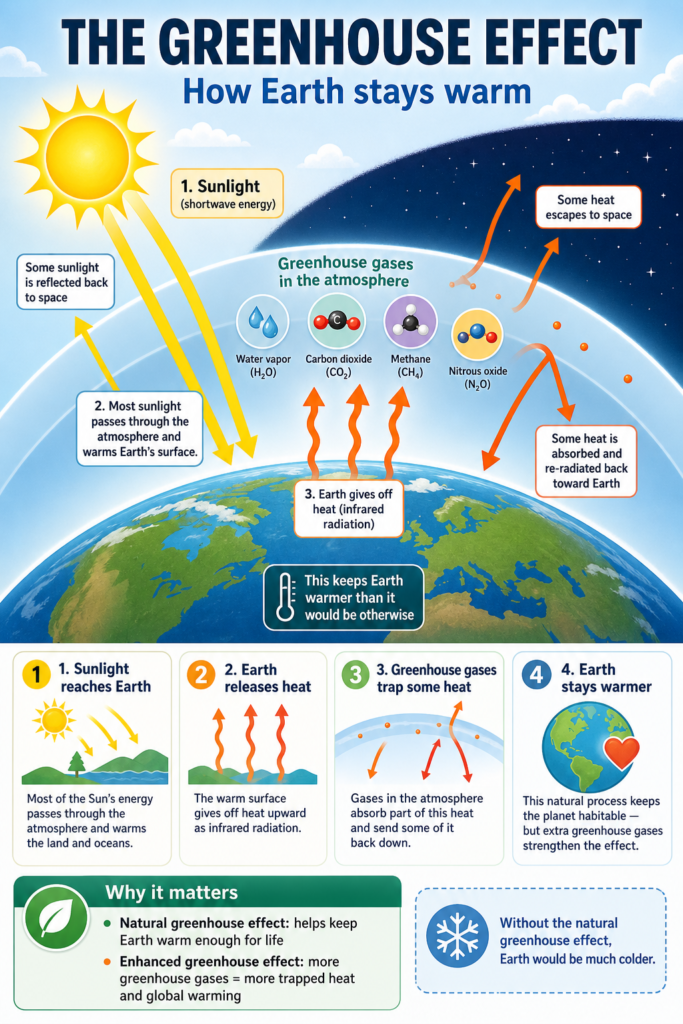
The greenhouse effect explained
Leave a Reply