
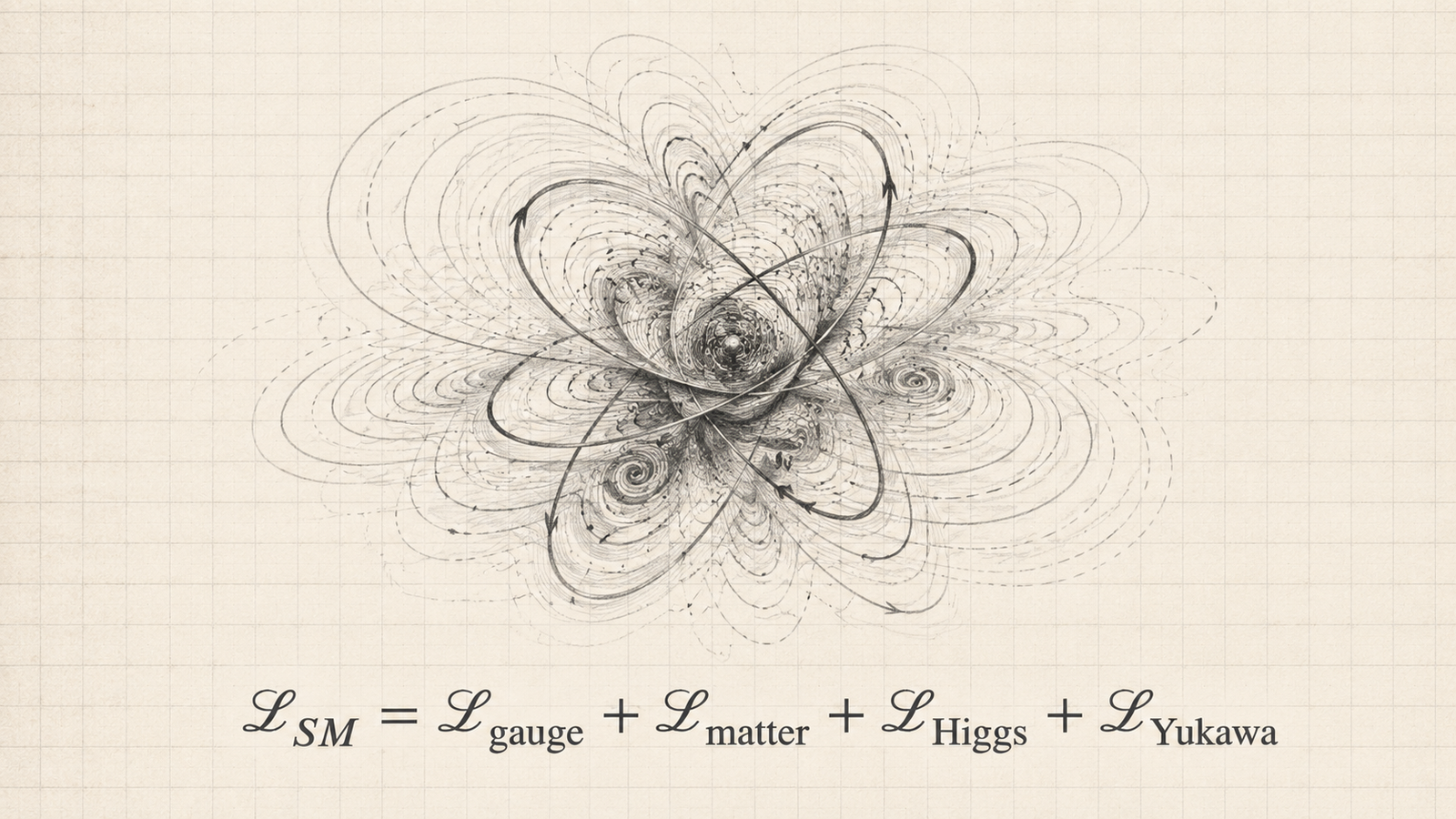
I just had a long convo about quantum mechanics and cosmology with my pal, Gemini von Google, and I wanted to share what I’ve learned because I never before came across some of the things I’ll share here with you.
Electromagnetic field
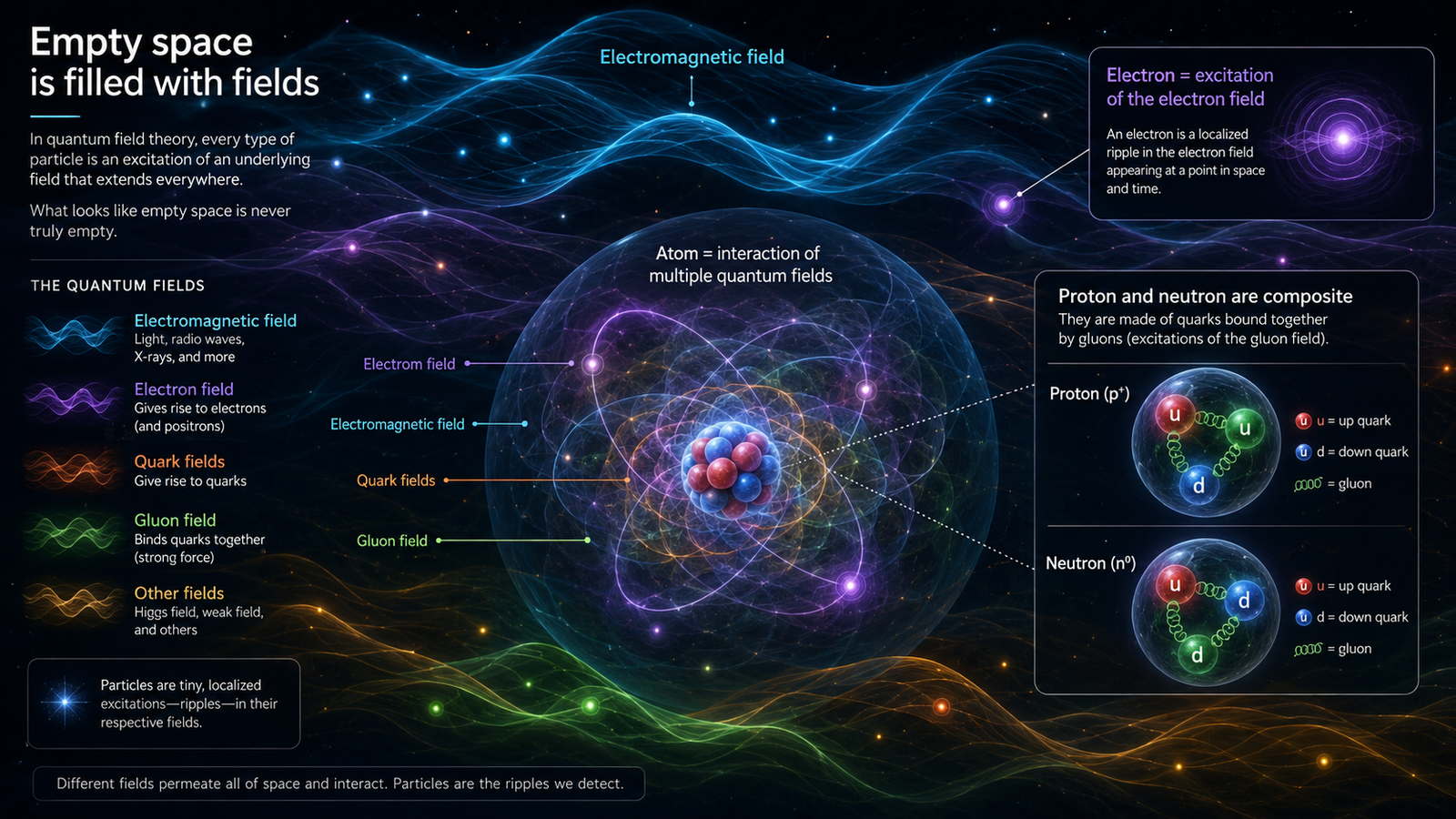
The electromagnetic field is sort of like an essential substrate pervading the whole universe — even the empty space. The word “field” sounds kinda 2D-ish, though. When we talk about fields we usually talk about football fields, battlefields, or grass fields. If I say that I’m doing a fieldwork, nobody’s first thought would be that I’m doing electromagnetic fieldwork. The electromagnetic field spans in all directions all across the universe. That’s why light can travel so far and seemingly through empty space — because empty space isn’t really empty, it’s imbued with electromagnetism. The EM field isn’t the only field. There are some 17+ other fundamental fields. Each fundamental particle has its own field. Personally, I always thought that an electron is excitation of the EM field, but that’s not the case — an electron has its own field. Neutrons and protons don’t have their own fields because they are composite particles, which means they are made of other, smaller particles such as quarks and gluons, which do have their own fields since they are fundamental.
Higgs field
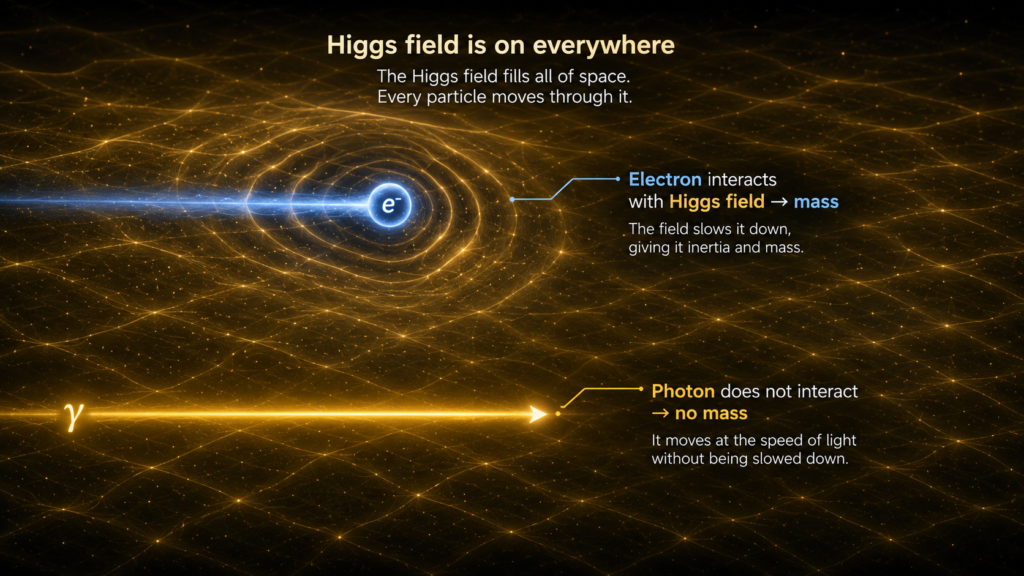
Probably the weirdest field is Higgs field. Unlike all the other fields that drop to zero in empty space, the Higgs field is basically “turned on” everywhere at a constant value. An electron that travels through space must basically “swim” against the strong currents of the Higgs field — this constant interaction creates drag and inertia which is basically how particles get their mass. Basically. Unlike electrons, photons have no mass because the electromagnetic field doesn’t interact with the Higgs field at all. This allows photons to travel through space at the maximum speed (the speed of light).
Space-time
I know what you’re thinking, “But Tommy, is gravity also a field”? First of all, don’t call me Tommy. Second — yes, gravity is something like a field, but scientists still aren’t quite sure if it’s a quantum field. The gravitational field is the geometrical structure of spacetime. Gravity is the physical manifestation of spacetime curving and warping in the presence of mass and energy. The best way to understand this is through physicist John Wheeler’s famous summary of Albert Einstein’s General Relativity:
Matter tells spacetime how to curve.
Spacetime tells matter how to move.
Physicists do not yet have a proven quantum theory for the gravitational field. There’s a missing link between gravity (space-time) and quantum mechanics, and this link is considered the holy grail of science.
Big Bang (That’s what she said)
Another thing that I learned today is that, contrary to my wrong opinion, the Big Bang didn’t start from a single point in space — it started everywhere all at once. At some point, the entire universe, which might or might not have been infinite to begin with, started violently expanding. This event took place some 13.8 billion years ago. But it’s nothing how I imagined it and nothing like what we were taught in school. The major problem I have with understanding the big bang theory is my lack of mathematical prowess. My intuition tells me that at the very beginning, there was an expansive empty space, and then at some point, there was a spark in the middle of it that lit it all up, but apparently, that is false. There was no void that got filled with matter after the bang. The universe isn’t all the matter inside the space, the universe is the space. Which leads me to my next point.
You gotta speak the lingo
We all love quantum mechanics and cosmology, but I think that’s only because we have such good teachers. From Carl Sagan and Richard Feynman in the 20th century all the way to Brian Greene and Niels DeGrasse Tyson today, our generations (x, Millennial, z) are blessed with an abundance of great teachers who all took on a mission to make science less scary and more popular. Without them, most of us would hate science, especially Quantum physics. On the subatomic level, our everyday intuition of how things work completely breaks. There are no perfect analogues in the macro world that we can use to understand the quantum world. Most of us see atoms as these tinny balls that make up everything. We were taught that atoms have nuclei consisting of a certain arrangement of protons and neutrons with electrons orbiting them. But the reality is different. A single atom is more like a point at which multiple quantum fields interact with each other — a tiny, very stable storm of sorts. Quantum mechanics is written entirely in math. Our brains are hard-wired to understand the world of classical physics. We cannot imagine something that is both a particle and a wave. For most of us, a ball is a ball, and a wave is a wave. But a single quantum particle can be both. In classical physics, we use math to describe objects we can see and manipulate. We can use math to precisely calculate the landing site of a cannon ball for example. But in quantum mechanics, math is the object. The Quantum Field Theory equations don’t just describe the behaviour of a field, they define it. The math allows physicists to predict the behavior of the universe to an astonishing degree of accuracy (sometimes down to 12 decimal places), even if they cannot draw a picture of what is happening. Our everyday language is way too limited and imprecise to deal with the exact science. We try to use words invented for a macro world to describe a realm where those concepts do not apply. I feel like knowing the right math is like knowing the right language. If physics were Klingon’s realm, then knowing the right math would be like knowing Klingon — very handy if you find yourself on Qo’noS, their home world. My point is, if it wasn’t for Brian Greene and Brian Cox, I would be completely lost when it comes to understanding quantum mechanics and cosmology. Everything we’ve been told about these conceptually dense subjects is just an approximate translation of what math is saying. I’m just saying
Anyway, follow me for more thought provoking and professional articles
Leave a Reply